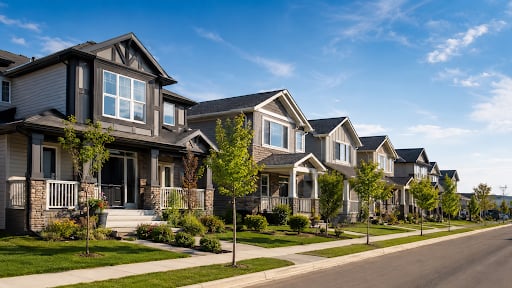
Panorama Hills is one of North Calgary's larger suburban communities, offering a mix of condos, townhomes and detached homes, strong access to north-side amenities and a housing stock that is mostly newer than many established Calgary neighbourhoods. For buyers, the trade-off is straightforward: you get housing variety and family-oriented amenities, but you also need to account for car dependence, property-specific fees, school designations and the maintenance cycle of homes built largely in the 2000s and 2010s.
Executive Summary
Panorama Hills is a large, relatively modern north Calgary community whose housing stock skewed heavily toward the 2000s–2010s build cycle, which matters for everything from typical home layouts to the age of roofs, furnaces, and condo reserve planning. Demographically, it's notably diverse: about 73% of residents in private households identify as a visible minority, and roughly 52% are first-generation Canadians—strong indicators of a multi-cultural community and broad housing demand across family and newcomer segments.
For buyers, the practical story is two-layered: (1) Panorama Hills' local price bands (wide because it contains condos, townhomes, and single-family homes with very different fee structures), and (2) the City of Calgary market cycle that shaped negotiation power between 2022–2026—tight in 2024–2025, easing into 2026 with higher months of supply and softer benchmark pricing.
In This Article
Location, commute and getting around
Who lives in Panorama Hills
Schools, amenities and community life
Home prices and market conditions
What buyers should know before buying
Frequently asked questions
What This Guide Covers
This research-style buyer guide evaluates Panorama Hills (north Calgary) through a practical lens: access and mobility, demographics, schools and amenities, safety signals, housing stock characteristics, and market pricing dynamics (2022–2026). Data sources include City of Calgary community profiles based on the 2021 Census, CREB® City of Calgary monthly statistics packages, Calgary Police Service reporting frameworks, rental market reporting from CMHC, and neighborhood-level listing aggregates (MLS-fed). Findings show (a) a younger, diverse, family-heavy community profile with strong ownership rates, (b) housing stock concentrated in the 2000s–2010s, (c) segmented pricing by housing type, with condos and townhomes providing entry points while detached homes command a substantial premium, and (d) market conditions that tightened materially by 2024–2025 and subsequently eased into 2026, affecting negotiation leverage and days-on-market.
How This Guide Was Built
This article uses a "triangulation" approach: official/public datasets for demographics and macro-market trends, plus neighborhood-level listing aggregates and local discussion forums to capture on-the-ground friction points a formal dataset doesn't show.
Primary sources used
City of Calgary Community Profile (Panorama Hills) built from the 2021 Census (demographics, income, household structure, housing stock).
CREB® City of Calgary Monthly Statistics (benchmark pricing, inventory, months of supply, days on market; district price benchmarks).
Calgary Police Service reporting framework (what is/isn't in the public Community Safety Dashboard; citywide annual statistical report context).
CMHC rental market reporting (vacancy and rent data at the CMA/zone level; used as a directional signal for rental demand).
Secondary sources used (clearly labeled where relevant)
Neighborhood listing aggregates and "MLS-fed" pricing snapshots (useful for current local ranges; imperfect for historical time-series by neighborhood).
Local discussion forum posts (anecdotal but high-signal for friction points like HOA access boundaries).
Limitations (important, because this is where buyers get burned)
Public-facing CREB® reports are excellent for city/district trends but do not provide a clean, official, downloadable neighborhood benchmark time series for Panorama Hills in the materials referenced here. Where this guide uses district (e.g., "North") benchmarks, it is explicitly described as a proxy, not a precise neighborhood-only metric.
Listing-aggregate pricing ranges (e.g., Zolo) are based on MLS-fed data and are best treated as "what's on the shelf right now," not definitive sold-price analytics for the entire neighborhood.
Location, Commute and Getting Around
Panorama Hills is part of north Calgary's growth belt—geographically positioned to benefit from quick vehicle access to ring-road style connectivity (via Stoney Trail corridors) and major north arterial routing, but it is still fundamentally a "car-first" suburban community. (This is not a moral judgment; it's just the operating reality for most buyers here.)
Calgary's public transit network coverage is citywide; for Panorama Hills specifically, Calgary Transit lists bus service routing in this district, including Route 114 (Panorama / Country Hills) with scheduled stops in and around the neighborhood.
Buyer implication: if your daily life depends on frequent CTrain access, Panorama Hills will likely feel less convenient than communities built around LRT stations. If your daily life is vehicle-based (or you're comfortable building your routine around bus service), the tradeoff is usually acceptable—especially given the neighborhood's housing variety and pricing tiers.
Who lives here and why it matters to buyers
The City of Calgary community profile (2021 Census-based) provides unusually actionable buyer insight: Panorama Hills is large (population in private households reported at 25,535) and materially shaped by migration and diversity.
What this usually translates to in practical buyer behavior (interpreted from the above data):
Strong demand for family-sized layouts and functional commuter housing.
A deep pool of resale buyers who care about "value per square foot" and school access more than being close to downtown nightlife.
Schools and day-to-day amenities
Schools
Panorama Hills has established school infrastructure and is served by the Calgary Board of Education. For example, Panorama Hills School reports serving elementary grades (K–6) in its published school information.
One non-negotiable for buyers with kids: school designations can change. The school itself posted designation-change information in late 2025 that describes re-designations affecting several grades and feeder patterns.
Amenities and recreation
Brokerage/local market descriptions emphasize Panorama Hills' ponds/pathways, community centre amenities, and nearby shopping nodes (often referenced as "Gates of Panorama Hills," Country Hills-area shopping, and broader north retail access). Treat these as directional but still useful context.
A more concrete (and buyer-relevant) amenity layer is the neighborhood's fee-funded community assets: the Panorama Hills Residents Association describes the annual fee as a mandatory encumbrance on land titles installed by the original developer (Genstar Canada) to fund maintenance/operations of community assets like the Panorama Hills Community Centre.
Panorama Hills Home Prices and Market Conditions
Panorama Hills "on-the-shelf" price ranges (local snapshot)
Using MLS-fed listing aggregates for a current neighborhood snapshot, the price segmentation is wide:
Panorama Hills current listing price bands (April 2026 snapshot)
Condos: average listing price ~$280,000; ~$215,000–$335,000 observed range.
Townhouses: average listing price ~$445,000; ~$280,000–$629,990 observed range.
Houses (single-family): observed active listing range roughly ~$598,888–$1,498,000 in the active set displayed (with many listings clustering ~$630k–$900k).
A separate market snapshot reports (as of March 30, 2026) a similar "whole-neighborhood" range: lowest ~$219,900 / highest ~$1,498,000 with an average asking price around $558k across active listings.
Inventory, days-on-market, and resale liquidity signals
At the City of Calgary level, March 2026 shows higher inventory and higher months of supply than March 2025, plus longer days on market—classic "more balanced / softer" conditions relative to the prior year.
At the Panorama Hills listing level, you can see how liquidity varies by housing type:
Active house listings ranged from very fresh (hours/days) to ~191 days on-market in the active set displayed—meaning pricing correctness matters, and not everything sells instantly.
The neighborhood-wide aggregate claims that "homes sell quickly" (high share under 10 days) should be treated as directional and cross-checked against the actual segment you're buying (condo vs townhouse vs house).
What Buyers Should Know Before Buying
This is the decision logic I'd use if you were sitting with Sam Geram Fard and wanted a clear "do we proceed or not" structure.
Define your non-negotiables
Commute tolerance
Shortlist micro-areas in Panorama Hills
Housing type
Price + monthly payment stress test
Decision rules that prevent expensive mistakes
Rule: underwrite the monthly carrying cost, not the sticker price.
Panorama Hills has condos, townhomes, and detached homes that can carry very different fee stacks (condo fees, association fees, HOA requirements). PHRA explicitly describes the annual fee as a mandatory encumbrance tied to land titles so you do not want to "discover" it after conditions are removed.
Rule: treat school designation as a moving part.
Designation changes are published and real. If schools matter, verify current designation at offer time.
Rule: align home age with your maintenance appetite.
The neighborhood's construction distribution means many homes fall into the "10–25 years old" maintenance cycle. That's totally fine—if you budget for it and inspect correctly.
Rule: don't outsource your sense of safety to vibes.
Use official reporting frameworks. CPS explains what their dashboard includes and excludes (and why some data isn't shown at community level). That context matters when people cherry-pick numbers.
The Bottom Line for Panorama Hills Buyers
Panorama Hills is a scale community: large population base, high diversity, solid ownership levels, and housing variety that creates multiple entry points (condo → townhome → detached). Its main "buyer friction" isn't a secret—it's the practical suburban tradeoffs: you must be comfortable with vehicle-based living (or disciplined transit planning), and you must verify whether your specific property is subject to condo structures, PHRA encumbrances, or HOA rules.
From a market standpoint, the 2022–2024 run-up in benchmark prices (especially for row/condo segments) is clear, and the March 2026 data shows measurable cooling relative to March 2025 across property types—bringing negotiation power back toward "balanced" in many situations, depending on the sub-segment and price point.
If you want a practical, family-oriented north Calgary community and you do your fee + document due diligence properly, Panorama Hills is a rational buy—not a romantic one.
Frequently Asked Questions
Is Panorama Hills a good community for first-time buyers?
It can be. Panorama Hills offers a wider range of entry points than many detached-heavy suburban communities because buyers can choose among condos, townhomes and detached homes. The right fit depends on monthly carrying costs, commute needs and the specific fees or restrictions attached to the property.
How much do homes cost in Panorama Hills?
The article's 2026 listing snapshots show a wide spread by property type, from condos in the low-to-mid $200,000s into the $300,000s, townhomes around the mid-$400,000 range on average, and detached homes commonly listed well above $600,000. Active-listing prices are not the same as sold prices, so buyers should use a current comparative market analysis before making an offer.
Does every Panorama Hills property have a residents' association fee?
No. Fee obligations can be title-specific. Buyers should have their lawyer confirm whether a Panorama Hills Residents Association encumbrance applies to the exact property and whether any balances or restrictions remain outstanding.
Is Panorama Hills good for commuting?
It works best for households that are comfortable driving or using north Calgary bus service. The community has useful road access, but it is not built around a CTrain station, so buyers who rely heavily on rapid transit should test the real commute before purchasing.
What should I inspect most carefully in Panorama Hills?
Many homes were built during the 2000s and 2010s, which means roofs, furnaces, hot-water systems, windows, grading and other lifecycle items deserve close attention. Condo and townhouse buyers should also review reserve-fund documents, fees and any planned special assessments.
Are schools guaranteed when I buy in Panorama Hills?
No. School designations and feeder patterns can change. Buyers who are choosing a home for a specific school should verify the current designation directly with the applicable school board before removing conditions.
Thinking About Buying in Panorama Hills?
Sam Geram-Fard can help you compare current listings, property-specific fees, neighbourhood trade-offs and resale considerations before you commit to an offer.
About Sam Geram-Fard
Sam Geram-Fard is a Calgary REALTOR® with RE/MAX Real Estate (Mountain View) and a Certified Negotiation Expert with more than 14 years of experience helping first-time buyers and families navigate Calgary's real estate market.
Disclaimer
This article provides general real estate information and is not financial, legal or tax advice. Home prices, fees, school designations, financing rules and market conditions can change. Confirm important property-specific details with qualified professionals before purchasing a home.